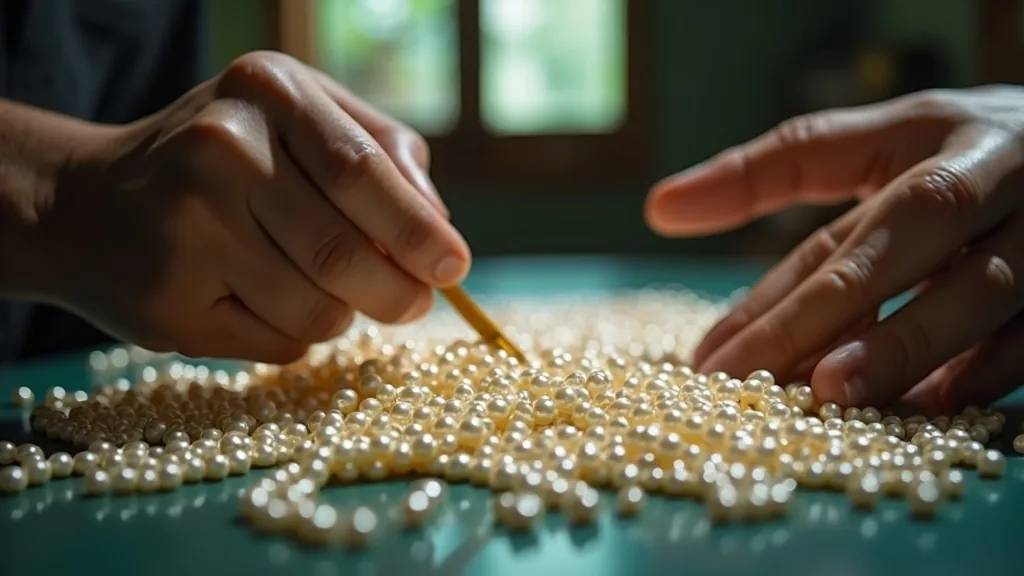
The ‘factory’ buyers audit here is our vetted partner facility network in Bali — coordinated, specified and inspected by our desk, not owned by it.
A Bali jewelry factory for South Sea pearls earns export orders at the bench, not the showroom. Bali Pearl Jewelry runs sorting, color-matching, goldsmithing, stone-setting, and a documented QC chain that takes loose Pinctada maxima pearls through to sealed export cartons — and B2B buyers can audit every step in person before committing to an order.
This page covers the facility itself: what the benches can build, how pearls are sorted and matched, which QC gates an export order passes, and how to schedule an audit. Wholesale pricing and OEM terms have their own pages.
What Can the Workshop Actually Build?
Pearl setting is a different trade from stone setting. A faceted sapphire tolerates prong pressure; a South Sea pearl does not — its nacre marks if a setter treats it like corundum. So the bench roster separates goldsmiths, who fabricate mounts in 18-karat gold and sterling silver, from pearl setters, who seat, peg, and knot.
Core bench skills, verified live during any audit:
- Peg-and-cup setting for half-drilled pearls — rings, pendants, studs — with seating depth checked before adhesive cure
- Hand-knotted strand work on silk, in graduated or uniform layouts for 9-16 mm rounds and drops
- Bezel, cage, and wirework settings that hold baroque shapes without point pressure on nacre
- Casting and hand-fabrication of custom mounts from buyer CADs or physical samples
Bench capacity is confirmed against your order at quotation rather than advertised as one flat number, because product mix moves the math: two hundred peg-set pendants run faster than forty fully knotted opera strands. As of 2026, sampling typically takes two to three weeks, and the production window is fixed in writing with the quotation.
How Are Pearls Sorted and Color-Matched?
Stock enters as graded loose lots from Indonesian farming regions — West Nusa Tenggara first among them. Lombok and Sumbawa waters anchor national supply, Sekarbela in Lombok serves as the recognized pearl trade center, and Bali itself farms Pinctada maxima in the Buleleng, Karangasem, and Negara districts, plus grow-out sites near Menjangan at the island’s northern tip.
Every lot then passes a five-stage sort:
- Size — sieved and calipered into 0.5 mm bands
- Shape — round, near-round, oval, drop, button, baroque
- Surface — blemish mapping under a 10x loupe
- Luster — reflection sharpness graded against retained master pearls
- Color — matched under daylight-standard lamps, never under mixed light
Color is where Indonesian origin genuinely matters. Indonesian and Australian golden South Sea pearls tend toward light champagne tones, while Philippine goldens reach deeper mustard saturation — so a champagne suite must be built from one coherent lot, not assembled from mixed origins and hoped flat.
One honesty note buyers should hold every supplier to: AAA/AA/A charts are trade conventions, not government standards. Every grade on our paperwork traces to physical inspection or an accompanying certificate — never assumption.
Which QC Steps Protect an Export Order?
Five checkpoints sit between your purchase order and the airport, each leaving a record you can request.
| QC checkpoint | What is checked | Record produced |
|---|---|---|
| Incoming pearl inspection | Size, gram weight, grade against PO, drill quality | Signed intake sheet with macro photos |
| Lot color-match approval | Tone consistency under daylight-standard lamps | Approval photo set sent to buyer |
| In-process bench check | Seating depth, adhesive cure, knot tension, metal finish | Batch checklist, initialed per bench |
| Final piece-by-piece QC | Luster, surface, setting security, hallmarking | Final QC report tied to order number |
| Export document pack | Certificates, permits, HS classification | Shipping dossier copied to buyer |
The paperwork layer is regulated, and it is worth knowing as a buyer. As of 2026, Indonesian pearl exporters need export approval under a Ministerial Regulation of the Ministry of Marine Affairs and Fisheries, plus a Quality Certificate (Sertifikat Mutu) and, where the destination requires one, a Certificate of Origin issued via the trade ministry. Lombok-origin shipments are physically inspected by BKIPM Mataram — the fish-quarantine and quality-control office — which issues a Health Certificate after online shipment reporting. Cultured pearls ship under HS code 7101210000 unworked and 7101220000 worked. Pearls themselves are not CITES-listed, though any coral or protected shell used in mixed-material pieces needs separate KLHK permits.
Why Run This From Bali and Lombok?
Because the supply is here. One industry source puts Indonesia at roughly 45% of global South Sea pearl production — worth around USD 500 million, or about 40% of global production value, as of 2014 — with a large share exported loose rather than as finished jewelry. Regional reporting shows the trade accelerating: cultivated pearl shipments from Lombok’s waters exceeded IDR 507.9 billion in 2023, up from IDR 209.2 billion in 2022, bound for Hong Kong, Japan, Australia, the United States, Switzerland, the UAE, and more than twenty other markets.
A factory sitting an hour’s flight from those farm gates buys earlier in the chain. Indicatively, as of 2026, Lombok loose South Sea pearls commonly trade around IDR 100,000-500,000 per gram, and single South Sea pearls at one Indonesian producer span USD 2 to USD 7,500 per piece — figures that move with luster, nacre thickness, surface, size, shape, and color, which is why every order is priced by written quotation per grade and size on our wholesale pages.
How Does a Factory Audit Visit Work?
- Send your scope. Message the BD desk with product category, target volumes, and market.
- Capability call. A 30-45 minute video call covering current bench work, the sorting setup, and QC records.
- Book the audit. NDA available on request; date and agenda confirmed in writing.
- Walk the factory. Benches, live sorting under the lamps, QC files from completed orders, sample pulls.
- Written follow-up. Capability summary and sample quotation within five working days.
| Audit option | Duration | What it covers | Indicative cost (as of 2026) |
|---|---|---|---|
| Virtual capability call | 30-45 minutes | Live video of benches, sorting station, QC records | No charge |
| Half-day factory audit | 3-4 hours | Bench observation, QC file review, sample inspection | No charge for qualified wholesale buyers; travel at buyer’s cost |
| Full-day audit + sorting session | 6-8 hours | Half-day scope plus supervised lot sorting and color-match approval | No charge for qualified wholesale buyers; travel at buyer’s cost |
| Two-day audit + Lombok extension | 2 days | Factory audit plus Sekarbela trade-center and farm-side sourcing visit | Quote-based; itinerary confirmed in writing |
Schedule a factory audit or capability call. Message the BD desk on WhatsApp at +62 811-3941-4563 or email bd@juaraholding.com with your product category and volumes, and the team will come back with call slots and audit dates. Bali Pearl Jewelry is part of Juara Holding Group — an Indonesian group operating from Bali across Indonesia since 2015.
Frequently Asked Questions
Can I visit a Bali jewelry factory that works with South Sea pearls before ordering?
Yes. Qualified wholesale buyers can book a half-day or full-day audit through the BD desk on WhatsApp at +62 811-3941-4563. You will see live bench work, supervised pearl sorting, and QC records from past export orders. An NDA is available on request, and the agenda is confirmed in writing before you fly.
What should a B2B buyer check during a South Sea pearl factory audit?
Watch setting work under a loupe, ask to see the daylight-standard lamps used for color-matching, and pull QC records from a completed export order. Then verify document capability: the quality certificate (Sertifikat Mutu), quarantine health certificates for Lombok-origin shipments, and correct HS codes — 7101210000 for unworked and 7101220000 for worked cultured pearls, as of 2026.
How does the factory color-match golden South Sea pearls for one order?
Golden pearls are sorted under consistent daylight-standard lighting, because tone shifts with the light source. Indonesian goldens usually sit in the light champagne range, so a matched suite is built from one graded lot, photographed, and sent for your approval before any drilling or setting starts. Grades trace to inspection or accompanying certificates, never assumption.
Can the factory ship both loose pearls and finished jewelry in one export order?
Yes. Loose lots ship as unworked cultured pearls and finished pieces as worked pearls or jewelry, each under its own HS classification. Lombok-origin shipments pass physical inspection by the fish-quarantine office in Mataram before a health certificate is issued. The BD desk consolidates both streams into one documented dossier, with pricing quoted per grade and size.