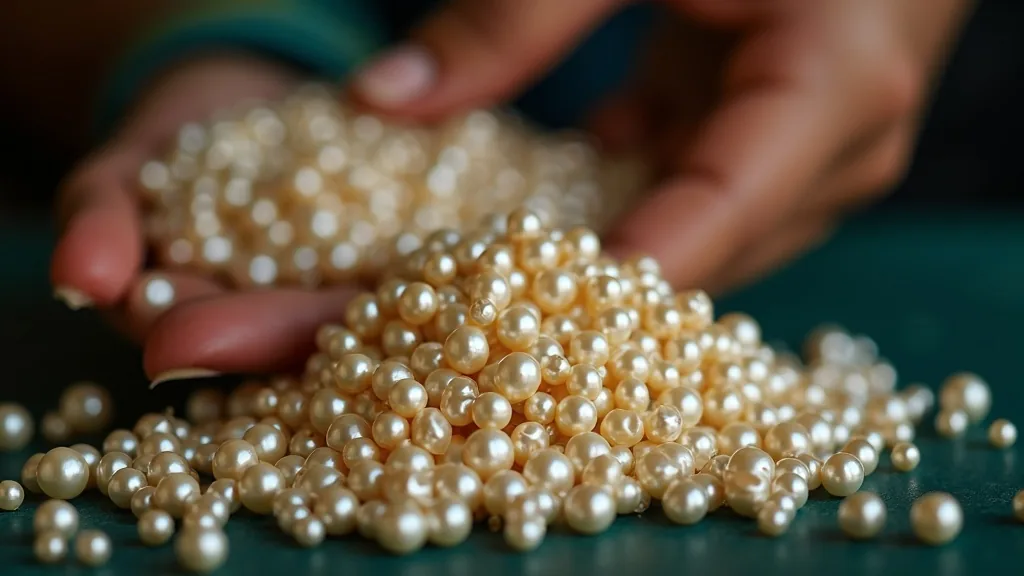
Bali loose pearls for sale means undrilled or half-drilled South Sea pearls from Pinctada maxima farms around Bali and Lombok, sold as singles or sorted parcels. Jewelers buy them per gram or per piece — Lombok loose goods commonly trade around IDR 100,000–500,000 per gram as of 2026 — and every grade is confirmed by inspection, with a written quotation before payment.
This page covers loose goods only — the pearls designers and bench jewelers buy to set, drill, and match themselves. Finished strands and the monthly-volume wholesale program have their own pages.
What Counts as a Bali Loose Pearl?
A loose pearl here is a cultured South Sea pearl from the oyster Pinctada maxima, harvested at Indonesian farms and sold before it touches a mounting. Bali itself has named production areas in Buleleng, Karangasem, and Negara districts, plus farms near Menjangan at the island’s northern tip — a long way from Kuta and Denpasar. West Nusa Tenggara (Lombok and Sumbawa) and Raja Ampat in West Papua supply most of the rest; Sekarbela in Lombok is the recognized retail and trade hub.
One industry source puts Indonesia at roughly 45% of global South Sea pearl production — around USD 500 million, or about 40% of world production value as of 2014 — with a large share exported loose rather than as finished jewelry.
On color, expect whites, silvers, creams, and goldens. Indonesian and Australian golden South Sea pearls tend toward light champagne tones; the deeper mustard saturation you may know from marketing photos is typically Philippine.
How Are Loose Pearls Priced — Per Gram or Per Piece?
Two systems run side by side. Commercial parcels — mixed drops, baroques, ovals — are priced per gram because value tracks material evenly across the lot. Fine singles are priced per piece: once a pearl is round, clean-skinned, and strongly lustered, two pearls of equal weight can differ several times over in value.
| Format | Typical buyer | Indicative range (as of 2026) |
|---|---|---|
| Mixed loose parcel (drops, baroques), per gram | Production studios, resellers | IDR 100,000–500,000 per gram — the common Lombok trade band |
| Graded parcel (near-round to round), per gram | Design houses building a line | Upper part of the IDR 100,000–5,000,000 per gram span from Indonesian market studies |
| Single pearl, per piece | Bespoke jewelers, collectors | USD 2–7,500 per piece at one Indonesian producer |
These figures are indicative, dated 2026; the written quotation confirms your price. The Indonesian Pearl Cultivation Association reported Lombok pearl prices rising from USD 5 to USD 16.3 per gram around 2011–2012 — this market moves.
Six variables set the price: luster, nacre thickness, surface condition, size, shape, and color. AAA/AA/A charts are trade conventions, not government standards — so a stated grade here always comes from physical inspection or an accompanying certificate, never a relabeled supplier claim.
Which Sizes, Shapes, and Drilling Options Can You Order?
| Size band | Shapes typically available | Usual application |
|---|---|---|
| 8–10 mm | Near-round, button, drop | Studs, small pendants |
| 10–12 mm | Round, near-round, oval, drop | Core ring and pendant lines |
| 12–14 mm | Drop, baroque, circled, some rounds | Statement pendants, brooches |
| 14 mm and up | Baroque, keshi-style, occasional rounds | One-off and collector pieces |
Parcels ship undrilled unless you say otherwise; half-drilling for posts, pegs, and cap settings is done per pearl before dispatch, at positions you approve on photos. Full drilling is available, though at that point you are really shopping strands.
What Sorting and Matching Services Come With a Parcel?
Sorting is where source-buying beats a reseller’s pre-packed bag. Standard service on any parcel:
- Size sieving into 0.5 mm bands
- Color banding — white, silver, cream, champagne, deeper golden
- Luster and surface sorting recorded in inspection notes
- Pair matching for earrings by face-up diameter, tone, and luster
- Layout matching across a multi-pearl design, photographed as a set
- Photos and video of the exact parcel — never stock images — before you commit
One honesty note: we are not a gem lab and print no certificates of our own. For higher-value singles an independent laboratory report can be arranged before shipment; otherwise the quoted grade follows our documented inspection.
How Does Ordering a Loose Parcel Work?
- Brief the desk. WhatsApp your size band, shape, color, drilled state, and budget per gram or per piece.
- Review real parcels. Photos and video of candidate parcels or singles arrive — daylight and fixed-lamp shots — with gram weights and millimeter measurements.
- Get the written quotation. It states the grade basis (inspection or certificate), the per-gram or per-piece price, and a validity date.
- Confirm and document. As of 2026, export requires KKP export approval (persetujuan ekspor Mutiara Indonesia), a Quality Certificate (Sertifikat Mutu), a Certificate of Origin where your destination asks for it, and a Health Certificate from BKIPM Mataram — which physically inspects every Lombok pearl shipment. Unworked loose pearls travel under HS code 7101210000.
- Dispatch. Insured courier with tracking; sort records stay on file so a repeat parcel matches the first.
> Request loose parcel photos and a quote. Send your size band, shape, color, and budget to the Juara Holding Group BD desk — WhatsApp +62 811-3941-4563 or bd@juaraholding.com — and current parcel photos with a written quotation follow. Bali Pearl Jewelry is part of Juara Holding Group, an Indonesian group operating from Bali across Indonesia since 2015.
Why Buy Loose Pearls at the Indonesian Source?
Because the volume, the paperwork, and the price formation all happen here. Cultivated pearl shipments from Lombok’s waters exceeded IDR 507.9 billion in 2023 — exports above IDR 430.5 billion plus domestic shipments above IDR 77.4 billion — up from IDR 209.2 billion total in 2022, according to provincial shipment records. Buyers that year included Hong Kong, Japan, Australia, China, Thailand, the United States, India, Switzerland, Singapore, the UAE, and more than twenty other markets.
The pattern is old: in 2010 Indonesia produced 5.7 tonnes of pearls and exported about 95%, mainly to Hong Kong, India, the Philippines, and Japan, for roughly USD 30 million — with exports growing 19.69% a year on average across 2008–2012. Buying loose here puts you at the first link of that chain.
On ethics: climate pressure and illegal fishing have pushed the industry from wild collection toward cultured farms, which makes water quality and farming practice legitimate questions. Ask them — we tell you which region a parcel came from and what we know of the farm’s practices, and where we do not know, we say so.
Frequently Asked Questions
Are Bali loose pearls sold undrilled or half-drilled?
Both. Parcels ship undrilled by default so you keep every setting option open. Half-drilling for posts, pegs, and pendant caps is done on request before dispatch, per pearl, at positions you approve on photos. Full drilling is possible too, but fully drilled and strung goods are quoted under strands, not loose parcels.
What is the minimum order for a loose pearl parcel?
There is no rigid floor. Singles start at the low end of the market — one Indonesian producer lists South Sea pearls from USD 2 per piece — while sorted parcels usually make economic sense from a few dozen grams upward. Tell the desk your budget and you get a straight answer on whether singles or a parcel serves it better.
How do I verify pearl grade before paying?
Ask for the inspection basis in writing. Your quotation states whether the grade comes from our physical inspection or an accompanying certificate, and photos and video show the exact parcel. For higher-value singles, an independent laboratory report can be arranged before shipment. Treat AAA/AA/A labels as trade shorthand — compare the stated luster, nacre, and surface, not the letters.
Can you match loose pearls to a sample I already own?
Usually, yes. Send photos of your sample beside a millimeter scale in daylight, and the desk sorts candidates by size band, tone, and luster before quoting. One caveat: Indonesian goldens run to light champagne, so a deep mustard gold — typical of Philippine production — may have no honest match in Lombok stock, and we say so rather than overpromise.