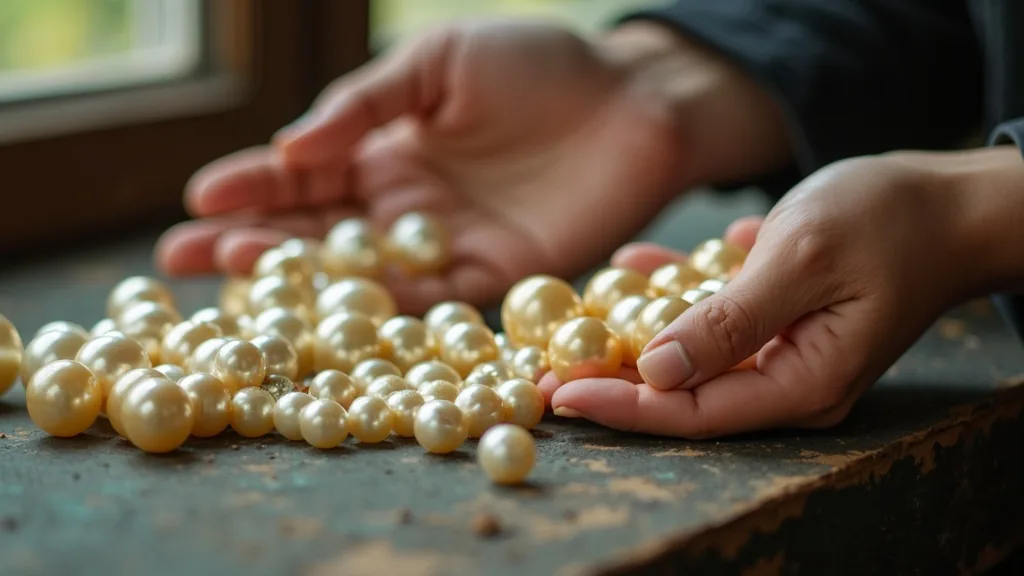
Bali South Sea pearl wholesale price is quoted per gram, per tier, and confirmed only by written quotation after lot inspection. As of 2026, Lombok loose South Sea pearls have commonly traded around IDR 100,000–500,000 per gram, with luster, surface, size, and shape setting the tier and volume breaks pulling the band lower.
This page deals strictly with the numbers — per-gram bands, volume breaks, minimum-order logic, and the gap between wholesale and retail. Partnership terms belong to our wholesale program page, and farm provenance belongs to our supplier page. If you already know what you need, jump to the price-sheet request form below and the BD desk will reply with dated figures.
What Is the Bali South Sea Pearl Wholesale Price in 2026?
The pearls behind these numbers come from Pinctada maxima oysters farmed off Lombok, Sumbawa, and Bali’s northern coast — Buleleng, Karangasem, and Negara are named production districts, with farms near Menjangan at the island’s northern tip, a long way from Kuta. One industry source puts Indonesia at roughly 45% of global South Sea pearl production, and Indonesian market studies report pearl prices spanning IDR 100,000 to IDR 5,000,000 per gram across all types and grades.
For loose South Sea lots specifically, the working wholesale bands as of 2026 look like this:
| Wholesale tier | Typical lot profile | Indicative band, IDR per gram (as of 2026) |
|---|---|---|
| Commercial | Mixed shapes, moderate luster, visible surface marks | 100,000–180,000 |
| Standard | Good luster, light blemishes, 9–11 mm near-rounds | 180,000–320,000 |
| Fine | High luster, clean surface, 11–13 mm rounds, white to champagne golden | 320,000–500,000 |
| Exceptional | Top luster, matched golden rounds above 13 mm | Above 500,000 — quoted strictly per lot |
Two honesty notes before you anchor on any row. First, AAA/AA/A grade charts are trade conventions, not government standards, so the grade behind a price must come from physical inspection or an accompanying certificate — never from a seller’s adjective. Second, these bands are indicative market observations. Only a written quotation on an inspected lot is a price.
How Do Volume Breaks Change the Per-Gram Price?
Wholesale pricing rewards volume because the fixed costs of a shipment — sorting, grading, quarantine inspection, export paperwork — barely change whether the parcel weighs 100 grams or 3 kilograms. Spread across more grams, those costs shrink per unit, and larger orders also earn priority in harvest allocation.
| Order volume | Typical adjustment vs base quote (indicative, as of 2026) | Logic |
|---|---|---|
| 50–250 g (entry MOQ) | Base wholesale quote | Smallest lot that absorbs sorting and documentation costs |
| 250 g – 1 kg | Around 3–7% below base | Consolidated grading, single shipment file |
| 1–5 kg | Around 7–12% below base | Priority allocation from the current harvest |
| Above 5 kg | Negotiated per harvest | Forward allocation agreed directly with farm partners |
The MOQ logic is practical, not arbitrary. Every Lombok pearl shipment — domestic or export — is physically inspected by BKIPM Mataram, the fish quarantine and quality-control agency, which issues a Health Certificate after online shipment reporting. That inspection plus the export file — export approval under the KKP ministerial regulation, a Quality Certificate, and a Certificate of Origin where the destination requires one — costs roughly the same for a small parcel as for a large one. Below about 50 grams, the paperwork eats the price advantage, which is why parcels that small rarely make wholesale sense.
How Wide Is the Retail-vs-Wholesale Spread?
Retail and wholesale are different products wearing the same pearl. At Sekarbela, Lombok’s recognized pearl retail and trade center, counters price finished pieces individually; one Indonesian producer lists single South Sea pearls anywhere from USD 2 to USD 7,500 per piece as of 2026. Wholesale lots trade by weight, before finishing, matching, and retail overhead are added.
The arithmetic makes the spread concrete. A 12 mm round of about 2.5 grams bought inside the fine band at IDR 400,000 per gram costs roughly IDR 1,000,000 loose. Set, matched, boxed, and sold across a retail counter, comparable pearls routinely ask several multiples of that figure — the difference pays for finishing labor, matching stock, and storefront margin, not better nacre.
Demand keeps the wholesale side liquid. Provincial trade figures show cultivated pearl shipments from Lombok’s waters exceeded IDR 507.9 billion in 2023 — over IDR 430.5 billion exported plus IDR 77.4 billion shipped domestically — up from IDR 209.2 billion in 2022, with 2023 buyers spread across Hong Kong, Japan, Australia, China, Thailand, the United States, and more than twenty other markets. Price history runs the same direction: the Indonesian Pearl Cultivation Association reported Lombok pearl prices climbing from USD 5 to USD 16.3 per gram around 2011–2012. None of that is a promise of appreciation — pearls are merchandise, not an investment product — but it does mean quoted bands move, which is why every price sheet we issue carries a date.
How Does the Wholesale Quotation Work?
- Brief the BD desk. Send sizes, shapes, colors, grade expectations, target volume, and destination country through the form below or by WhatsApp.
- Receive the indicative price sheet. Dated per-gram bands and volume breaks matched to your brief, usually within two working days.
- Inspect the lot. Live video inspection, or in person in Bali or Lombok. Grades are confirmed against the actual pearls, with certificates where they accompany the lot.
- Lock the written quotation. Price per gram, lot weight, and validity window in writing — that document, not this page, is the price.
- Complete the documentation. Deposit confirmed, then BKIPM Mataram inspection and Health Certificate, KKP export approval, Quality Certificate, and Certificate of Origin where required.
- Ship and reconcile. Lots ship under HS code 7101210000 (unworked) or 7101220000 (worked), with weights reconciled against the quotation on arrival.
Request the 2026 Wholesale Price Sheet
The current price sheet — per-gram bands by tier, volume breaks, and MOQ terms, dated and signed — goes out through the BD desk of Juara Holding Group, an Indonesian group operating from Bali across Indonesia since 2015. Tell us what you buy and where it ships; we answer with numbers, not adjectives.
- WhatsApp: +62 811-3941-4563
- Email: [bd@juaraholding.com](mailto:bd@juaraholding.com)
Frequently Asked Questions
Why is the Bali South Sea pearl wholesale price quoted per gram instead of per piece?
Loose lots mix sizes, shapes, and surfaces, so weight is the only consistent unit both sides can verify on a scale. Per-piece pricing starts once a pearl is finished or exceptional — one Indonesian producer lists single South Sea pearls from USD 2 to USD 7,500 per piece as of 2026. For parcels, per-gram bands plus lot inspection is the cleaner mechanism.
How much below retail is the wholesale price for South Sea pearls in Bali?
There is no fixed discount percentage. Wholesale per-gram lots exclude finishing, matching, and counter overhead, so a fine-band pearl bought around IDR 320,000–500,000 per gram as of 2026 commonly resells at a per-piece retail ask several multiples higher at centers like Sekarbela. The honest comparison is your written quotation against finished-piece prices in your own market.
What order volume unlocks a lower per-gram pearl price?
Meaningful breaks typically begin above 250 grams, indicatively 3–7% below the base quote, widening to roughly 7–12% between 1 and 5 kilograms as of 2026. Above 5 kilograms, pricing shifts to negotiated harvest allocation. Every break is confirmed only in the written quotation after the lot is inspected, never assumed from this page.
Which documents confirm the grade behind a wholesale pearl quotation?
Grades come from physical inspection or certificates that accompany the lot — AAA/AA/A charts are trade conventions, not government standards, so no grade is asserted without one or the other. Export lots additionally carry a BKIPM Mataram Health Certificate, KKP export approval, a Quality Certificate, and a Certificate of Origin where the destination market requires it.