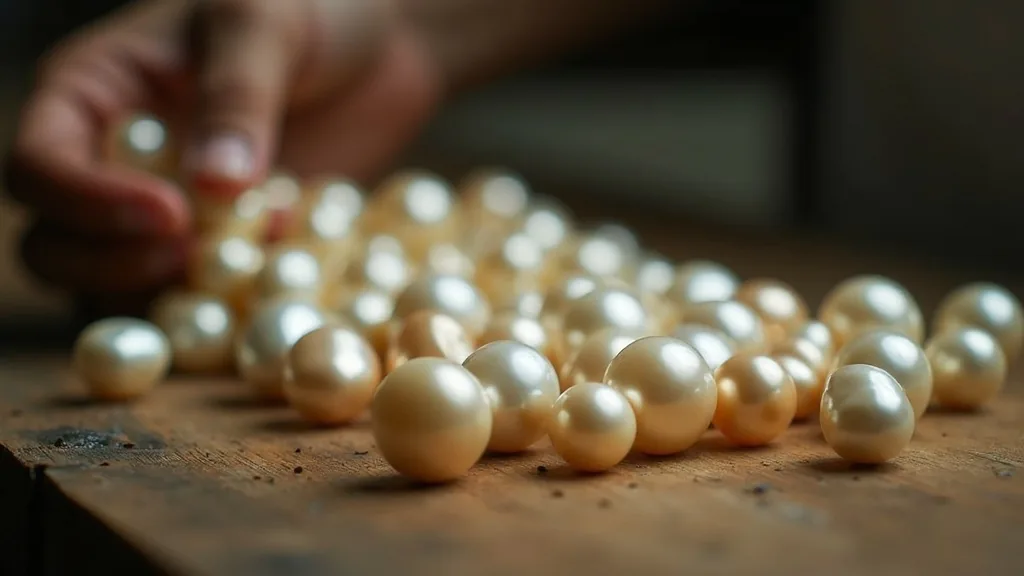
A south sea pearl grading guide comes down to five measurable factors: luster, surface, shape, size, and color with its overtone. Indonesian exporters rank lots on an AAA–AA–A scale — a trade convention, not a government standard — so every serious quotation pairs the letter grade with inspection notes or a certificate rather than a bare claim.
This guide covers how each factor is judged in Lombok and Bali, how grades translate into price per gram, and what documentation should reach you before money moves.
What Are the Five Value Factors in South Sea Pearl Grading?
South Sea pearls grow inside Pinctada maxima, the largest commercially cultured pearl oyster, and Indonesia is the heavyweight producer — one industry source credits the country with roughly 45% of global South Sea pearl production, worth around USD 500 million or about 40% of global production value as of 2014. Graders in Lombok, Sumbawa, and north Bali weigh the same five factors that buyers in Hong Kong and Tokyo check on arrival:
| Factor | What the grader checks | Effect on price |
|---|---|---|
| Luster | Sharpness of light reflected off the nacre — mirror-like edge vs soft glow | The single biggest driver; crisp luster can double a lot’s value |
| Surface | Pits, wrinkles, and chalky patches, viewed at arm’s length and up close | Clean-faced pearls take the premium; visible flaws discount fast |
| Shape | Round, near-round, oval, drop, button, circled, baroque | Rounds cost the most; matched drops and baroques sell on character |
| Size | Diameter in millimeters; South Sea typically runs 8–20 mm | Non-linear — one 15 mm pearl outprices two 11 mm pearls combined |
| Color & overtone | Body color (white, silver, cream, golden) plus overtone (rose, green) | Even, saturated golden and bright white-rose lead export demand |
Two of these — luster and surface — cannot be judged from a spec sheet. That is why our quotations attach per-lot inspection notes and daylight photographs instead of quoting a letter grade in isolation.
How Do Indonesian Exporters Use the AAA–AA–A Scale?
The letter scale compresses those five factors into three trade bands. Used honestly, it speeds up sorting and quoting; used loosely, it hides a multitude of chalky surfaces.
| Grade | Luster | Surface | Typical buyer |
|---|---|---|---|
| AAA | Sharp, mirror-like reflection | Face at least 95% clean; flaws invisible at arm’s length | Fine jewelry houses, matched strands, top golden rounds |
| AA | Good luster with slightly soft edges | Roughly 80–90% clean face | Mid-range finished jewelry; pendants and earrings where one face shows |
| A | Noticeably soft luster or visible marks | 70% clean or less | Commercial jewelry, carved settings, accent pieces |
One caution: formal AAA/AA/A charts are trade conventions, not standards issued by any government body, and thresholds shift from house to house. We state grades only from physical inspection under standard lighting or an accompanying certificate — never from a supplier’s word.
Why Do Nacre Thickness and Golden Color Origin Matter?
Nacre is the pearl itself. South Sea pearls stay in the oyster for two years or more, so a healthy Lombok or Bali harvest carries thick nacre — the depth that produces durable, layered luster. Thin-nacre pearls can look fine at sale and turn dull within two years, which is why serious buyers ask for nacre condition in writing.
Golden color deserves the same scrutiny. Natural golden South Sea pearls from Indonesian and Australian waters tend toward light champagne tones, while Philippine goldens reach deeper mustard saturation. Dyed and irradiated “goldens” also circulate in the trade, so a deep, uniform gold offered at champagne-lot prices should raise questions, not excitement. Our inspection notes state color origin; for large matched golden lots an independent laboratory report can be arranged before deposit — see the golden south sea pearl price page for how natural saturation bands are quoted.
How Does Grade Drive Price Per Gram?
Indonesian market studies report pearl prices from IDR 100,000 up to IDR 5,000,000 per gram depending on type and grade, and Lombok loose South Sea pearls commonly trade around IDR 100,000–500,000 per gram — figures current as of 2026, with the written quotation confirming every lot. Single South Sea pearls at one Indonesian producer span USD 2 to USD 7,500 per piece, which shows how violently the five factors compound.
| Trade band (convention) | Indicative loose-pearl range, as of 2026 | What moves a lot inside the band |
|---|---|---|
| A / commercial | IDR 100,000–250,000 per gram | Surface coverage, shape mix, size spread |
| AA | IDR 250,000–500,000 per gram | Luster sharpness, matching across the lot |
| AAA, 12 mm+ rounds | IDR 500,000–5,000,000 per gram | Natural golden saturation, flawless faces, strand matching |
These are indicative anchors, not offers; every quotation is priced per grade and size at the time of inspection. Demand supports the top bands: cultivated pearl shipments from Lombok’s waters exceeded IDR 507.9 billion in 2023 — up from IDR 209.2 billion in 2022 — with buyers spread from Hong Kong and Japan to Switzerland and the UAE. The climb is not new: the Indonesian Pearl Cultivation Association reported Lombok prices rising from USD 5 to USD 16.3 per gram around 2011–2012, and Sekarbela in Lombok remains the recognized trade center where loose stock changes hands daily.
For live numbers by category, see south sea pearl price per gram and our wholesale south sea pearls terms. Volume buyers sourcing loose south sea pearls at wholesale or commissioning OEM pearl jewelry receive tiered quotations by grade band and size step.
How Does a Graded Lot Quotation Work?
- Send your specification. Size range in millimeters, shape, color, grade band, and quantity — plus destination country, since documentation differs by market.
- We pull and grade candidate lots. Stock comes from partner farms in Lombok, Sumbawa, and Bali’s northern coast — Buleleng, Karangasem, and the waters near Menjangan — graded under standard lighting against the conventions above.
- You receive a written quotation with inspection notes. Per-lot millimeter sizes, gram weights, luster and surface comments, color origin, and daylight photos or video of the actual pearls — never stock images.
- Confirm, and documents follow. As of 2026, export approval under the KKP ministerial regulation, a Quality Certificate, and a Certificate of Origin where the destination requires it; BKIPM Mataram physically inspects every Lombok shipment and issues its Health Certificate.
- Insured shipping. Lots travel under HS 7101210000 (unworked) or 7101220000 (worked), with the grading paperwork in the parcel.
> ### Request a Graded Lot Quotation
>
> Tell the BD desk your size, shape, color, and grade band, and receive a written, inspection-backed quotation — usually within two working days. WhatsApp +62 811-3941-4563 or email [bd@juaraholding.com](mailto:bd@juaraholding.com). Bali Pearl Jewelry is part of Juara Holding Group — an Indonesian group operating from Bali across Indonesia since 2015. Prices are quote-based per grade and size; the written quotation confirms.
Frequently Asked Questions
Is there an official government standard for grading South Sea pearls?
No. AAA/AA/A charts are trade conventions maintained by exporters and jewelry houses, not standards issued by the Indonesian government. As of 2026, regulators such as KKP and BKIPM Mataram control export approval, quality certificates, and shipment health inspection — not letter grades. A stated grade is only as good as the inspection or certificate attached to it.
How do I verify a pearl lot’s grade before paying?
Ask for per-lot inspection notes: millimeter sizes, gram weights, luster and surface comments, color origin, and daylight photos or video of the actual pearls. For high-value matched lots, request an independent laboratory report before placing a deposit. Any exporter unwilling to document a lot this way is asking you to buy the letter, not the pearls.
Does nacre thickness appear on a grading certificate?
Not always — many trade grading sheets skip it, so request it explicitly. South Sea pearls cultured for two years or more typically carry thick nacre, which sustains luster for decades; thin nacre dulls quickly and undercuts resale quality. A written note on nacre condition, or a lab measurement for premium lots, closes that gap.
Are golden South Sea pearls graded on the same scale as white ones?
Yes — the same five factors and the same AAA–AA–A conventions apply, but color saturation adds a layer of its own. Indonesian and Australian goldens run light champagne; Philippine goldens reach deeper mustard tones. Always confirm in writing that the gold is natural rather than dyed or irradiated, because treatment changes the price band entirely.